Call for Abstracts and Panel Sessions for “Sociology of Ruptures and Futures: Communities, Change, and Continuity”
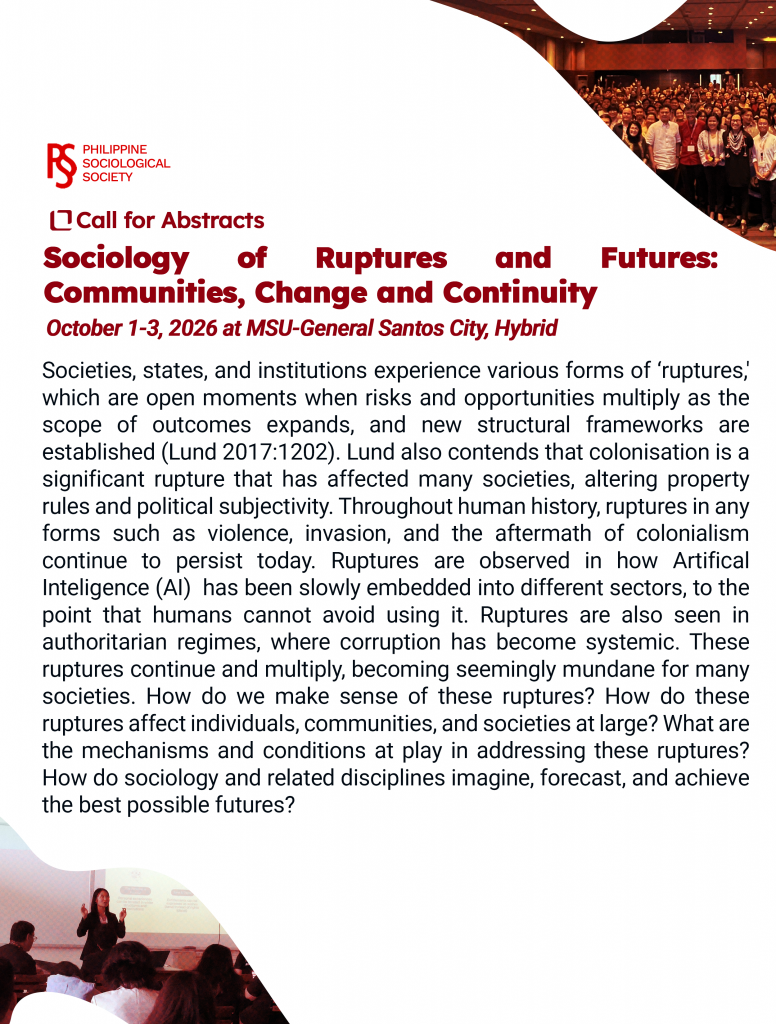
Societies, states, and institutions experience various forms of ‘ruptures,’ which are open moments when risks and opportunities multiply as the scope of outcomes expands, and new structural frameworks are established (Lund 2017:1202). He also contends that colonisation is a significant rupture that has affected many societies, altering property rules and political subjectivity. Throughout human history, ruptures in any forms such as violence, invasion, and the aftermath of colonialism continue to persist today. Ruptures are observed in how AI has been slowly embedded into different sectors, to the point that humans cannot avoid using it. Ruptures are also seen in authoritarian regimes where corruption has become systemic. These ruptures continue and multiply, becoming seemingly mundane for many societies. How do we make sense of these ruptures? How do these ruptures affect individuals, communities, and societies at large? What are the mechanisms and conditions at play in addressing these ruptures? And how do sociology and related disciplines imagine, forecast, and achieve the best possible futures?
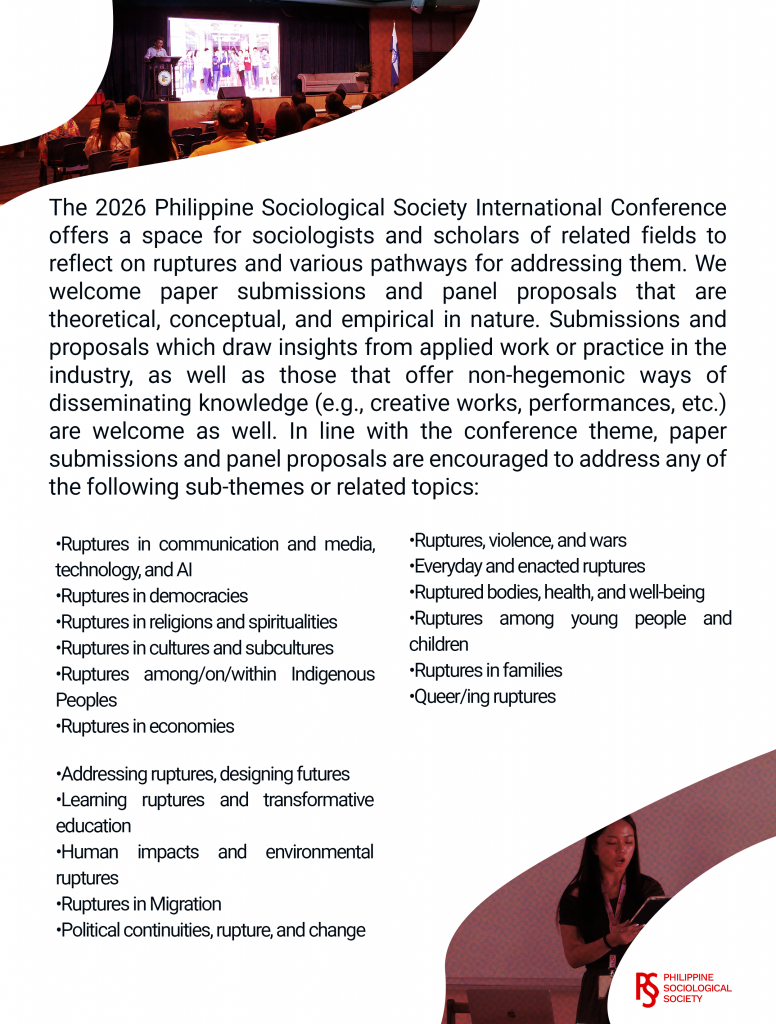
The 2026 Philippine Sociological Society International Conference offers a space for sociologists and scholars of related fields to reflect on ruptures and various futures for addressing them. We welcome paper submissions and panel proposals that are theoretical, conceptual, and empirical in nature. Submissions and proposals which draw insights from applied work or practice in the industry, as well as those that offer non-hegemonic ways of disseminating knowledge (e.g., creative works, performances, etc.) are welcome as well. In line with the conference theme, paper submissions and panel proposals are encouraged to address any of the following sub-themes or related topics:
- Ruptures in communication and media, technology, and AI
- Ruptures in democracies
- Ruptures in religions and spiritualities
- Ruptures in cultures and subcultures
- Ruptures among/on/within Indigenous Peoples
- Ruptures in economies
- Ruptures, violence, and wars
- Everyday and enacted ruptures
- Ruptured bodies, health, and well-being
- Ruptures among young people and children
- Ruptures in families
- Queer/ing ruptures
- Addressing ruptures, designing futures
- Learning ruptures and transformative education
- Human impacts and environmental ruptures
- Ruptures in Migration
- Political continuities, rupture, and change
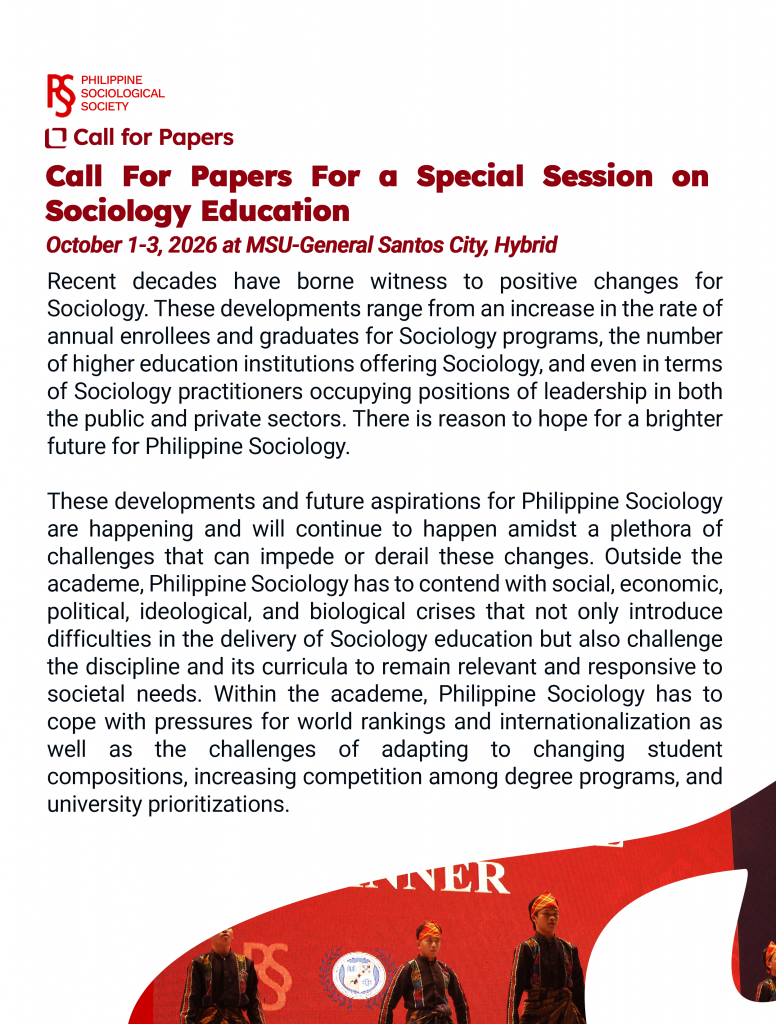
Call for Abstracts for a Special Session on Sociology Education
Recent decades have borne witness to positive changes for Sociology. These developments range from an increase in the rate of annual enrollees and graduates for Sociology programs, the number of higher education institutions offering Sociology, and even in terms of Sociology practitioners occupying positions of leadership in both the public and private sectors. There is reason to hope for a brighter future for Philippine Sociology.
These developments and future aspirations for Philippine Sociology are happening and will continue to happen amidst a plethora of challenges that can impede or derail these changes. Outside the academe, Philippine Sociology has to contend with social, economic, political, ideological, and biological crises that not only introduce difficulties in the delivery of Sociology education but also challenge the discipline and its curricula to remain relevant and responsive to societal needs. Within the academe, Philippine Sociology has to cope with pressures for world rankings and internationalization as well as the challenges of adapting to changing student compositions, increasing competition among degree programs, and university prioritizations.
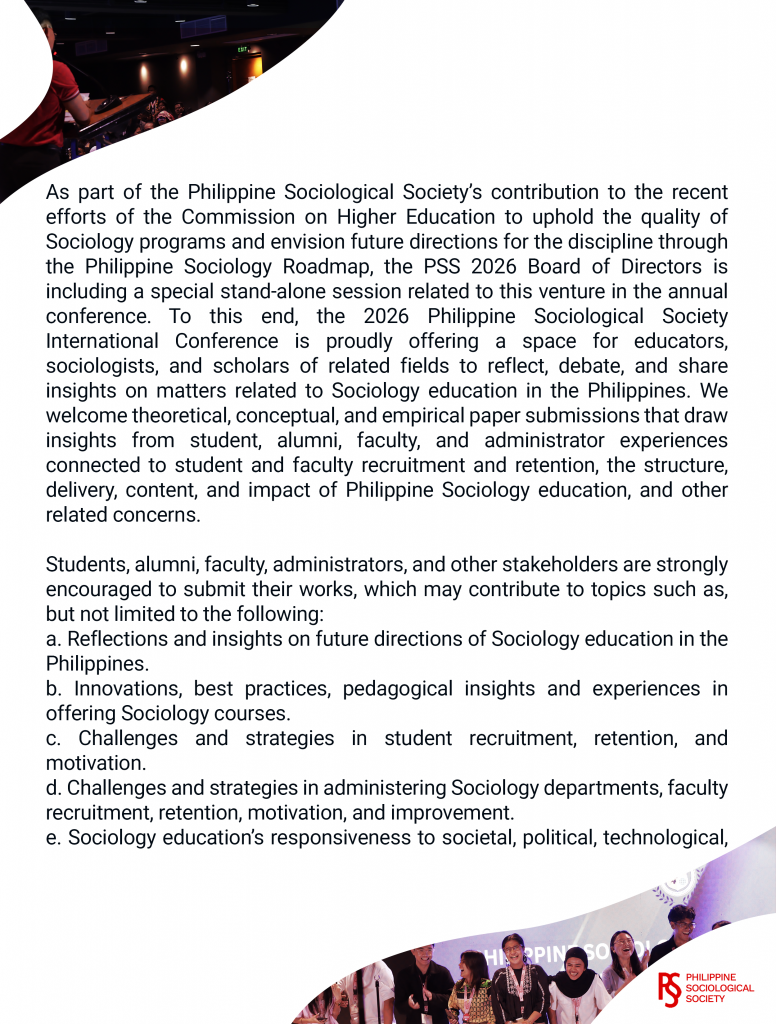
As part of the Philippine Sociological Society’s contribution to the recent efforts of the Commission on Higher Education to uphold the quality of Sociology programs and envision future directions for the discipline through the Philippine Sociology Roadmap, the PSS 2026 Board of Directors is including a special stand-alone session related to this venture in the annual conference. To this end, the 2026 Philippine Sociological Society International Conference is proudly offering a space for educators, sociologists, and scholars of related fields to reflect, debate, and share insights on matters related to Sociology education in the Philippines. We welcome theoretical, conceptual, and empirical paper submissions that draw insights from student, alumni, faculty, and administrator experiences connected to student and faculty recruitment and retention, the structure, delivery, content, and impact of Philippine Sociology education, and other related concerns.
Students, alumni, faculty, administrators, and other stakeholders are strongly encouraged to submit their works, which may contribute to topics such as, but not limited to the following:
a. Reflections and insights on future directions of Sociology education in the Philippines.
b. Innovations, best practices, pedagogical insights and experiences in offering Sociology courses.
c. Challenges and strategies in student recruitment, retention, and motivation.
d. Challenges and strategies in administering Sociology departments, faculty recruitment, retention, motivation, and improvement.
e. Sociology education’s responsiveness to societal, political, technological, environmental, cultural, and demographic developments in a post-COVID-19 Philippines.
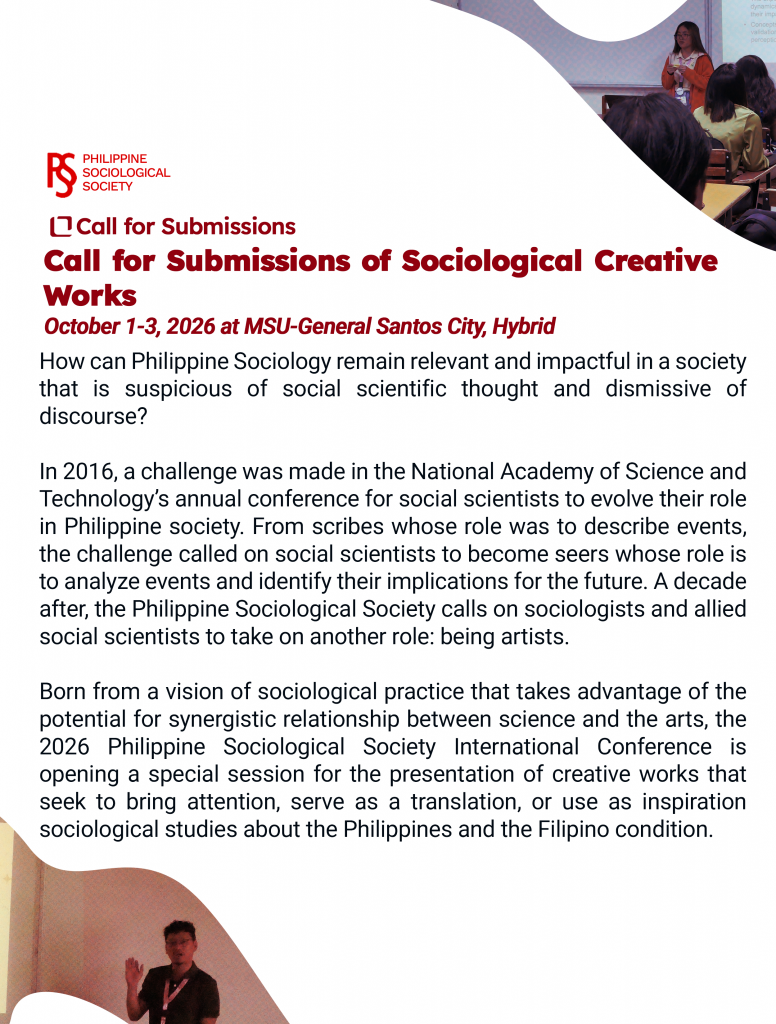
Call for Submissions of Sociological Creative Works
How can Philippine Sociology remain relevant and impactful in a society that is suspicious of social scientific thought and dismissive of discourse?
In 2016, a challenge was made in the National Academy of Science and Technology’s annual conference for social scientists to evolve their role in Philippine society. From scribes whose role was to describe events, the challenge called on social scientists to become seers whose role is to analyze events and identify their implications for the future. A decade after, the Philippine Sociological Society calls on sociologists and allied social scientists to take on another role: being artists.
Born from a vision of sociological practice that takes advantage of the potential for synergistic relationship between science and the arts, the 2026 Philippine Sociological Society International Conference is opening a special session for the presentation of creative works that seek to bring attention, serve as a translation, or use as inspiration sociological studies about the Philippines and the Filipino condition.
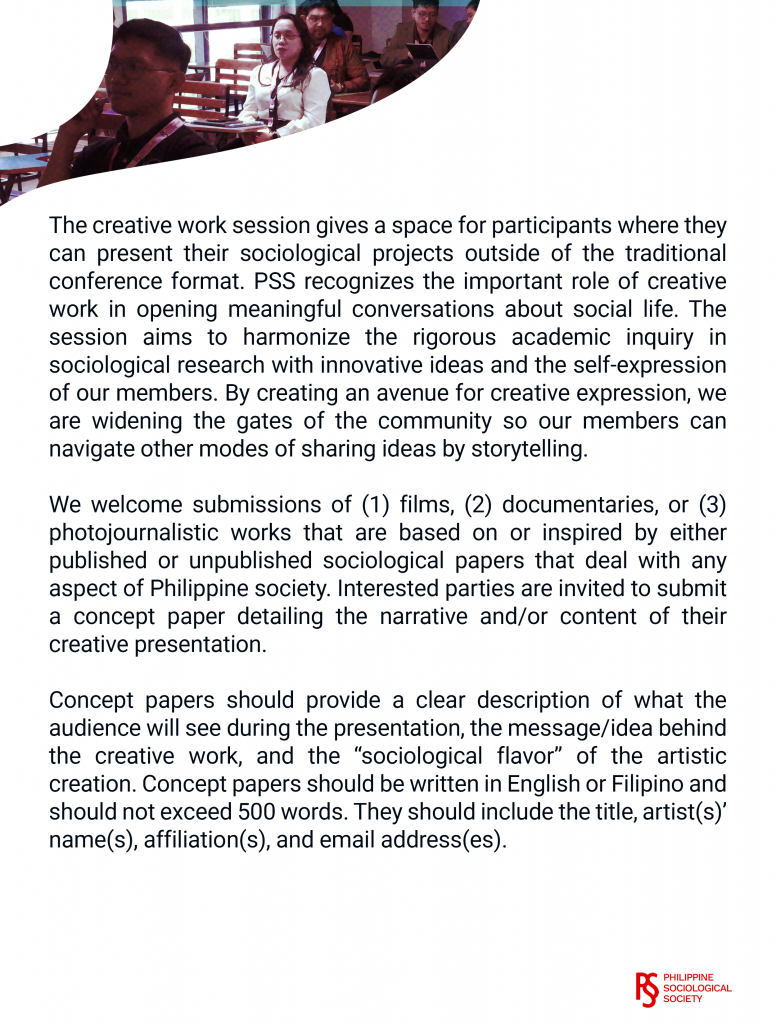
The creative work session gives a space for participants where they can present their sociological projects outside of the traditional conference format. PSS recognizes the important role of creative work in opening meaningful conversations about social life. The session aims to harmonize the rigorous academic inquiry in sociological research with innovative ideas and the self-expression of our members. By creating an avenue for creative expression, we are widening the gates of the community so our members can navigate other modes of sharing ideas by storytelling.
We welcome submissions of (1) films, (2) documentaries, or (3) photojournalistic works that are based on or inspired by either published or unpublished sociological papers that deal with any aspect of Philippine society. Interested parties are invited to submit a concept paper detailing the narrative and/or content of their creative presentation.
Concept papers should provide a clear description of what the audience will see during the presentation, the message/idea behind the creative work, and the “sociological flavor” of the artistic creation. Concept papers should be written in English or Filipino and should not exceed 500 words. They should include the title, artist(s)’ name(s), affiliation(s), and email address(es). Abstracts should be written in English or Filipino (Tagalog and Bisaya)* and should not exceed 250 words. Abstracts should include the title, author(s)’ name(s), affiliation(s), and email address(es).
Abstracts may be submitted through this link:https://bit.ly/PSSIC26-SubmissionForm by 17 May 2026. Submissions will be reviewed by the Scientific Committee and the Creative Works Committee, respectively. Notifications about the status of abstract submissions will be sent by 15 July 2026.
Please be advised that the special sessions on SOCIOLOGICAL CREATIVE WORKS and SOCIOLOGY EDUCATION will be held as a PURELY ONSITE EVENT.
For more information, please contact the PSS Secretariat at: philippinesociology@gmail.com . We look forward to your participation at the 2026 PSS Conference.
*Other local languages will be considered, depending on the composition of the Scientific Committee.